


Rare bronze pendulum mantel clock, Gothic cathedral style, with automaton, circa 1830
Key facts
- Gothic Cathedral Mantel Clock with Automaton
- around 1830
Description
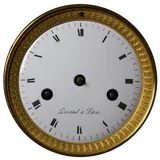
Rare bronze pendulum mantel clock, Neo-Gothic cathedral style with automaton, c. 1830 The fire-gilded bronze case is modelled on a Gothic church, featuring the characteristic pointed arches, stained-glass windows, spire-topped towers, buttresses etc., a tower surmounting the structure with a belfry (the bell hammer is triggered by the clockwork mechanism), and a window-like insert beneath the dial, backed with cobalt glass. The clock stands on its original matching two-part plinth (later whitewashed, with various missing sections in the stucco decoration); the spiral gong is mounted within this (connected to the clockwork by a thread). The fire-gilding is in good condition; the columns and the plinth are slightly worn. The case was completely dismantled, all individual parts were thoroughly cleaned (it was originally entirely lacquered in gold bronze), many screw connections were replaced, and the case was subsequently reassembled. The functioning movement, with a thread suspension and hook escapement, runs for about one week and strikes the half and full hours on a spiral gong located in the plinth; furthermore, the chime is indicated by the bells located in the tower (the small hammer rises accordingly, connected to the movement by a cord); this has been fully overhauled and readjusted. The fine, fire-gilded bronze dial with Roman numerals and a raised bezel is in good condition The plinth and the clock are dispatched separately, so the buyer must thread the striking mechanism’s cord themselves (it is hooked into the movement using small hooks). Dimensions: Height: 64 cm Width: 32 cm Depth: 21 cm Clock: Height: 51.5 cm Width: 19 cm Depth: 11.5 cm The key, pendulum and a bell are included in the offer. A rare original version; as the bases have usually been lost, the clocks have been converted to a simple bell strike (the cases almost always have the corresponding holes for the automatic mechanism and gong). Bibliography: Pierre Kjellberg, *La Pendule Francaise*, p. 450, figs. A and B