


Museum-quality, fire-gilded bronze pendulum clock inscribed with ‘Qui que tu sois, je suis ton maître’ (‘Whoever you are, here is your master’), attributed to Verneuil in Épernay, Louis XVI style, c. 1780
Key facts
- Production time
- 1780
- Country of manufacture
- France
Description
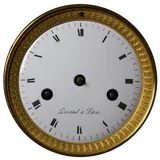
Museum-quality, fire-gilded bronze pendulum clock “Qui que tu sois, je suis ton maître” (“Whoever you are, here is your master”) marked Verneuil à Épernay Louis XVI, c. 1780 The beautiful case is supported by four flat feet; the movement is set in the centre, crowned by Cupid surrounded by clouds; to the left of this, a woman kneels in prayer whilst Cupid places a laurel wreath upon her head; to the right, two lovebirds can be seen. The fire-gilding is in good condition for its age. The white Carrara marble is slightly mottled in places and shows a few barely visible hairline cracks; a small hole on the front has been filled; the ribbon bearing the inscription ‘Qui que tu sois, je suis ton maître’ was presumably removed during the French Revolution (cf. *La Pendule Française*, Pierre Kjellberg, p. 244, fig. C) The movement is superbly crafted; it strikes the half-hours and full hours on a bell. It also features a date mechanism (controlled by the striking mechanism). The movement was presumably modified in the mid-19th century, i.e. the pendulum suspension was altered. The movement has been thoroughly cleaned and re-adjusted. The dial is marked ‘Verneuil a Epernay’ (see *Horlogers Francais*, Tardy, p. 640); the minute markings and the signature are applied in gold. The delicate, hand-sawn hands are also fire-gilded; the date hand is blue-tempered. As the clock is made of solid marble (no plaster core) and bronze, it weighs approx. 30 kg. Dimensions: Height: 46 cm Width: 34 cm Depth: 20 cm The pendulum, key and a bell are included in the offer. A similar clock by Charles Le Roy is housed at the Palace of Versailles.