


Fire-gilded Empire-style bronze Kalliope mantel clock, circa 1815
Key facts
- Empire Pendulum Clock
- around 1815
Description
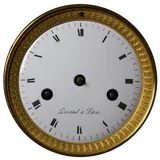
A large, perfectly preserved, fire-gilded Empire/Louis XVIII bronze ‘Kalliope’ pendule, circa 1815/20, signed Pickard and Pons A plinth supported by four feet and divided by an acanthus leaf moulding, featuring a relief (fanfares, garlands, laurel wreaths, curving horns); above this, centred, is the clockwork mechanism upon which the muse Calliope sits, adorned with a wreath and a fanfare, flanked by several books and a laurel branch. The depiction of Calliope resembles that in Raphael’s fresco *Parnassus* (1509–1510) (see also Raphael’s *Stanzas*) in the Apostolic Palace, which, in its central panel, depicts Apollo alongside the nine Muses. The original fire-gilding (matt and polished) is in very good condition, as are the polished areas (sides and back); only the matt gilding has very few blemishes (visible only in oblique light). The case was completely dismantled, all individual parts carefully cleaned and then reassembled. The functioning movement, featuring a thread-suspension pendulum, lever escapement and lock-disc striking mechanism (full and half hours), was expertly overhauled and adjusted, with a power reserve of approximately 8 days; this is in keeping with the work of Pickard and Pons (Pierre-César Honoré Pons (1773–1851)). The guilloché, fire-gilded dial with Roman numerals has been re-inscribed. Dimensions: Height: 53.5 cm Width: 42 cm Depth: 15.5 cm The key, pendulum and a bell are included in the offer. This clock originally came from a major Parisian collection.