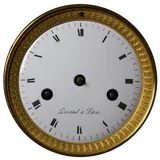



A highly refined table regulator with a lever escapement and central seconds hand by Ferdinand Berthoud, housed in a masterfully crafted Carrara marble case dating from 1796
Key facts
- Production time
- 1796
- Country of manufacture
- France
Description
A large, exquisitely fine table regulator with a lever escapement and central seconds by Ferdinand Berthoud, in a masterfully crafted Carrara marble case dating from 1796 Ferdinand Berthoud (18 March 1727 – 20 June 1807) was one of the most outstanding watchmakers of his era; he made a particularly significant contribution to chronometer construction (development of the chronometer escapement with a balance wheel in 1771). It is thought that Abraham Louis Breguet also worked for him. He was court watchmaker to Louis XV and to his grandson, Louis XVI. The movement is superbly finished; it is driven by two mainsprings. The cogs (reverse-cut and finely polished) and the gear wheels have a clean, geometric shape; the plates are made of hammered (hardened) brass sheet (bearings show only slight wear); the pinion of the scissor escapement is fitted with a centrally positioned, visible pin, the ‘scissors’ engage from the right, and the shaft extends all the way through to the dial (seconds shaft). The dial is inscribed with ‘Ferdinand Berthoud’; it is slightly chipped around the winding crowns. The delicate Directoire hands, made of gilded brass, are shaped like a lyre crowned by a star. The striking mechanism is controlled via a lock disc; it strikes on the half-hour and full hour. The movement has been thoroughly cleaned, and all steel components (screws, levers, springs) have been re-blued. The rust-compensating pendulum is typical of those manufactured in Berthoud’s workshop; it consists of two brass halves (connected by two screws) with a lead insert between them. The clock achieves optimal accuracy (approximately 1 second per day); both mainsprings are still original and date from 1796. The 64 cm high case, crafted from the finest Carrara marble, is also a small masterpiece in its own right; the top is made entirely from a single piece and is supported by four simple columns. The clock is crowned by a large oil lamp and four small flame finials made of fire-gilded bronze; a simple laurel wreath is set into the plinth, which is supported by four flattened spherical feet. The rear cornice (back) of the head is slightly chipped; the front left column is slightly chipped at the top edge; a small marble plaque (front right, glued at the top), the base of the oil lamp (mounted on top of the head) is broken in the centre. Dimensions: Height: 64 cm Width: 31.5 cm Depth: 14 cm